July 06, 2007

Stationary traveller

It's getting just a little bit frustrating, thinking of the good weather and the places I might have gone to, while still being stuck in the office.

I haven't written a whole lot recently, so I haven't mentioned my new wheel truing stand that I picked up for a song on eBay. It's made by Ultimate and resplendent in anodised red aluminium and black cast iron. Ok, it's no Hozan, but it's solid and being one-sided it makes the wheel that bit more accessible. The trueness indicators have spring loaded tool steel tips, so you can spin the wheel and see where it graunches, without worrying about cutting into the sidewall. Having built all my previous wheels using the bike frame as the guide, it's light years more convenient having a proper stand. I also splashed out and bought a proper ergonomic spoke key; my three-way one is versatile but really uncomfortable to use. Like my Park PRS-15 workstand, having the right tools for the job really does make a difference. My Look CX6 carbon pedals had been sitting in a box and doing nothing since January, and after all those knee problems I have no intention of using Looks again. BentMikey bought them from me for his Hurricane upgrade project and he likes them a lot. I've actually been very happy with my el cheapo Shimano SPD pedals, which are on both the Speedmachine and Annie the Blue Bike, but they're a wee bit heavy and seem remarkably rust-prone, so I'll be looking for stainless hardware in future.

Meanwhile...

The big project begins and I'm excited! So far I have in front of me the following yummy parts:
  • FSA Carbon Pro Team Issue chainset (in hard-to-get 175mm)
  • RPM ISIS bottom bracket
  • Shimano XTR front derailleur [1]
  • Shimano Deore XT rear derailleur
  • Shimano Deore XT 9spd cassette
  • Sram PC-951 chain
  • Shimano Dura Ace bar end gear levers
  • Shimano Deore LX SPD pedals
  • Mavic A719 rim, laced to a Hope Mono hub with DT Swiss Revolution spokes
  • Sun CR-18 rim, laced to a Hope Mono lightweight hub with plain gauge stainless spokes
  • Kore lightweight stainless QRs
  • Avid Single Digit 7 v-brake
  • Avid Ultimate v-brake
  • Shimano Ultegra cartridge headset
Half of the above is actually second-hand, but a carefully chosen second-hand. I'm quite happy to pay £6 for a bottom bracket that's only done a few miles, but I'd only buy a brand new headset. I don't have the tyres yet, but they're on order. They're a new model from Schwalbe and apparently quite difficult to get hold of. I've also got some more 3T cork bar tape, the same as I used on the bar ends on both Annie and the little Helios. It's super comfortable and is nice to hold even in the rain. I also have some very solid padlocks, just in case you're having other ideas.

The frame...well the frame's still top secret because it hasn't arrived yet. None of that aluminium nonsense though. Steel is real, man.

[1] From the days when XTR was burnished blue and aluminium, and looked like jewellery for bikes. I think it's one of the loveliest components they ever made.

May 23, 2007

Speedmachine front suspension disassembly

I've written this page to be as much of a parallel reference as a standalone. Alex Rice detailed the disassembly of his Speedmachine's suspension fork and I used his notes to aid the disassembly of mine. The moving parts of the fork are inside a rubber boot and inside the frame, so nothing is visible for the uninitiated.

Alex noted that the HP Velotechnik boys are very good at designing bikes and not nearly so good at writing instructions, and I agree. I have the instruction manual for the bike and for the fork it provides no diagrams and no real clue as to what might need to be adjusted, and why. It goes so far as to say:

The adjustment of the fork play requires special tools and skills. Please have your bicycle mechanic perform this maintenance work. The following section refers to the expert.

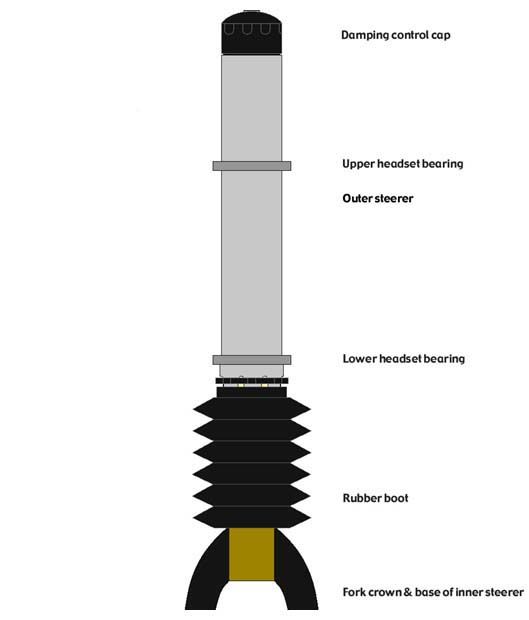
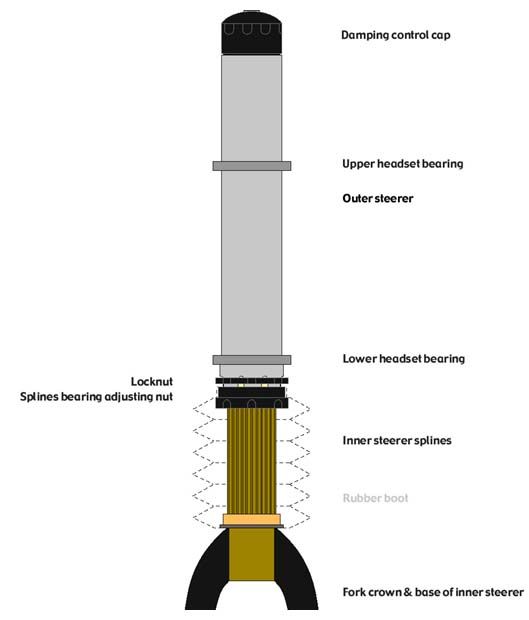
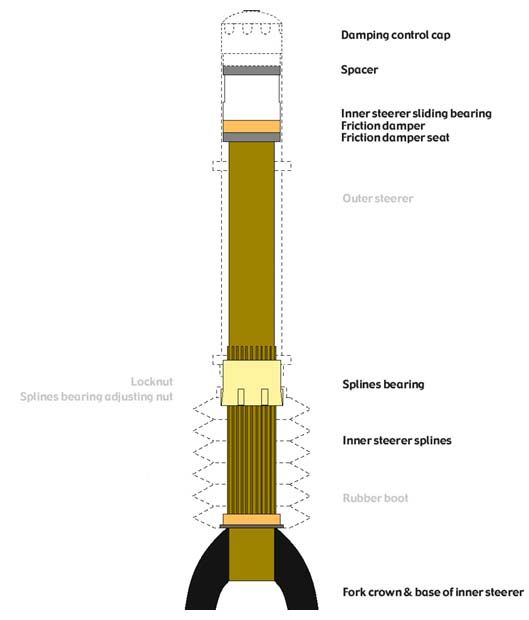
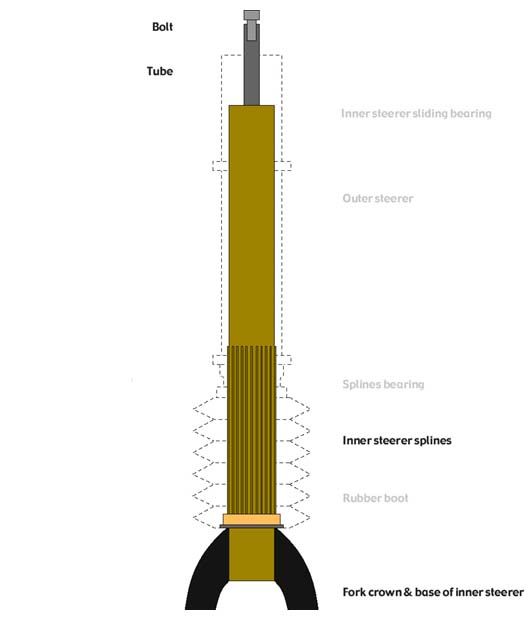
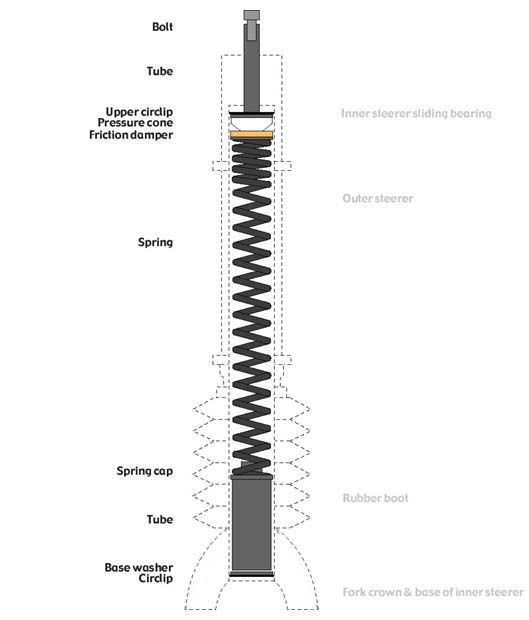
Many years ago, I was a paid bicycle mechanic. I also have an engineering masters, and I still found the instructions difficult. I have therefore created some illustrations [1], so that one might have a better idea of what lies within before doing any unbolting of things.

There are three main issues you might have with the fork: it can squeak for unknown reasons (as did Alex's, and Dave Larrington's), the movement can become stiff and reluctant, and it can start to wobble as might happen with a loose headset. Mine was wobbling a little, enough to be disconcerting when powering uphill with the front of the bike moving around.

How does the fork work? How does it adjust?


The fork is essentially very simple, but made slightly more complicated by having externally adjustable damping. The fork itself has a long steerer and it slides up and down within a larger tube. Sandwiched between the two tubes are a plastic sliding bearing at the bottom and a teflon [2] sliding bearing at the top. The larger tube rotates inside the two headset bearings, and protrudes at the top where the handlebar stem is attached. So that you can actually steer, the steerer tube has a set of splines which engage with the inside of the plastic bearing, and the plastic bearing is splined to fit inside the end of the larger tube. This way everything turns together.

Friction damping is provided by two flat doughnut-shaped pieces of foam. The larger one is sandwiched between the two tubes, and the smaller is pressed against the inside of the steerer tube. The damping is made adjustable by the black control cap at the very top of the larger tube; as you tighten the cap down, it compresses the larger piece of foam.

The coil spring in the fork sits inside the steerer tube. At the bottom end it sits on a tube and is retained by a washer and a large circlip, and at the top by the base of a small tube which is connected directly to the black cap. As the fork compresses over a bump, the steerer tube slides upwards through the larger tube, and the spring is compressed because the black cap stops it moving upwards and the circlip stops it moving downwards out of the fork. The small tube ends in a flat section where the spring butts up against, and when the fork is at maximum extension, the flat section butts up against a circlip at the top of the inner steerer. Got all that?

If you need to adjust the fork, you can (in theory) do it without removing it from the frame. I couldn't tell what I was really adjusting when I was trying to adjust-out the slight wobble, so I removed the fork from the frame and took it completely apart to find out. Once you've removed the stem and the front brake, the fork can be tapped out of the frame by using a soft mallet on the top of the steerer. Mine was quite tight the first time.

Once you've hammered the fork out of the frame, have a think through the X-ray view here and the following pictures. You won't be able to take the fork apart further unless you remove the spring first so that you can slide the inner steerer into the outer to access the small tube. And you won't be able to hammer the fork back into the frame properly unless you remove the spring first, because the suspension will do its job of absorbing shocks, and do it rather well. So for disassembly, the first thing you should do is remove the spring, and this can be done whether the fork is still mounted in the frame or not. There is a slight preload on the spring: a couple of millimeters, according to the book, so be careful when you remove the circlip from the fork crown. This isn't the time for bodgery, you'll want proper internal circlip pliers.

What's inside, and taking things apart

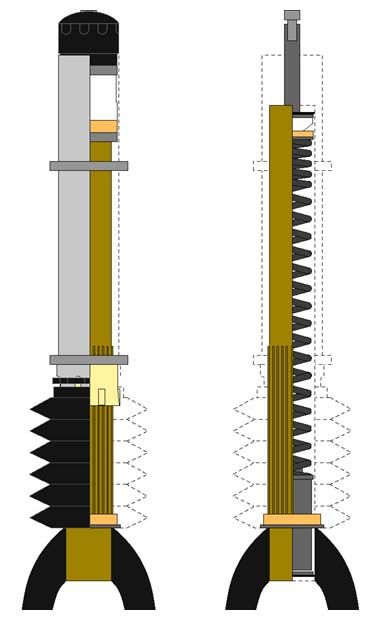
With the fork removed from the frame, it'll look like this:


Peel the rubber boot down from the top and you should see the splines, the locknut, and the adjusting nut which bears directly on the bottom edge of the plastic sliding bearing:


For reference, here are the components which are sandwiched between the inner and outer steerer tubes:


You can see that if the outer steerer is held tightly in its big bearings, the inner steerer can wobble if either or both of the plastic splines bearing or the teflon upper sliding bearing are worn. The lower bearing is slightly tapered externally, and by turning the adjusting nut to force the bearing upwards into the outer steerer tube, it contracts fractionally onto the splines of the inner steerer, thus taking up any wear. The locknut is then snugged down onto the adjusting nut. I found it impossible to make this adjustment with the fork still in the frame, and very difficult to make the adjustment even when I could see everything. One might use a very time-consuming trial-and-error approach by adjusting the bearing pressure, reassembling the fork in the frame and checking for movement. I set the nut pressure just short of when the inner steerer became stiff to slide up and down inside the plastic bearing. Personally, I think Cannondale's Headshok needle bearing approach might take out some of this guesswork. I used Park Tool's HCW-5 lockring spanner.

That all said, the inner and outer steerers won't come apart until you unscrew the damping control cap from the outer steerer and you then unscrew the top bolt from the small tube that will be visible having unscrewed the cap. You'll need pliers on the small tube to hold it. The cap will then be free and you can slide the outer steerer up and off the inner:

Ok, not much to see there, but that's the inner steerer exposed. It will be a bit greasy and any grit that gets into the splines won't do them any good. Without the spring in place, the small tube can drop out of the bottom of the inner steerer and you'll find attached to it a chamfered teflon piece [2,3] and the second foam doughnut. Here is what's inside the inner steerer before anything is taken apart:

Reassembly

In true Haynes manual fashion, installation is the reverse of removal. More or less. With the spring out of the fork, reassemble the inner and outer steerers with their components, and with the outer steerer in place, check the plastic sliding bearing for the correct tightness. If it's ok, hold the small tube with the pliers and reattach the damping control cap and screw it a few turns into the outer steerer. Remember that it is one of several components that takes the full load of the suspension, so screw it back in until all the thread is hidden. There will still be a few turns of adjustment available and you may not need it screwed all the way in. Slide the fork assembly back into the frame and it'll wobble around until the lower bearing begins to seat itself. You will then need a drift such as a 1/2 inch diameter pipe, 18 inches long or so. I used a piece of lawnmower handle. Put the drift up inside the inner steer and carefully, but firmly, hammer the fork back into the frame. It'll go in anything from 1/4 inch to 1/2 inch more, and you can tell when it's fully seated as the sound of the hammer hitting the drift will raise in pitch and the blows will suddenly feel solid.

You can then put the spring, the spring cap, the tube, the washer and the circlip back into the bottom of the fork. You might want to use the drift again to preload the spring while you put the circlip in place. With the wheel in the fork and the bike on the ground again (you were using a workstand, weren't you?) you can press on the frame to make sure the fork is seated, and snug the stem as far onto the steerer as it'll go. The upper headset bearing cover should be vaguely stiff to turn. This is my main criticism of HP Velotechnik's design; the whole assembly is largely the same as any Aheadset setup, but without the starfangled nut by which you apply the correct preload before clamping the stem. No starfangled nut, no preload - other than pushing on the frame. With the fork in place, bounce the bike a few times and re-check the movement. If it still wobbles, for example, I recommend jumping up and down and swearing, before taking it all apart again. You might get away with knocking the fork halfway out of the frame, until the bearing locknut is visible, but on my bike the bearings were already out of their seats at that point, and the fork wobbled in the frame.

Where did that bit go again?

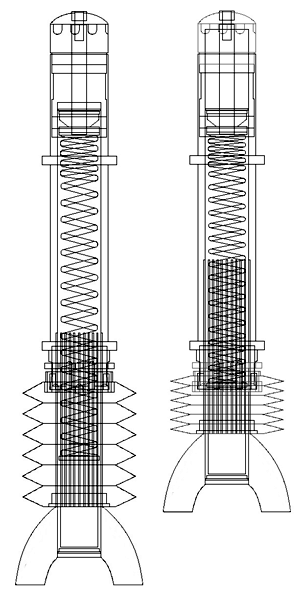
For comparison purposes (and just because I was on a roll with Adobe Illustrator that day) here are two cutaway views of the fork:

[1] I made some sketches as I disassembled things. I only made one measurement, so the illustrations aren't completely to scale. They're near enough, though.

[2] Well, I'd like to think it's teflon. It might actually be Nylon 66 or something.

[3] I didn't sketch everything, however. Some of the internal components such as the pressure cone I drew from memory and so might not be quite right. I didn't take everything apart again, just to check.

Pause for thought

All things considered, I've decided I don't like finding myself in hospital very much. A day would be tolerable, but a whole week! Still, least said, soonest mended.

In the meantime though, if I can't be working out on bikes, at least I can be working on them. After a good while scouring tool shops and bike shops and eBay, I finally managed to buy a lockring spanner (the old sort, shaped like a hooked 'C') which meant I could adjust the fork on my Speedmachine. It was with some trepidation and much reading of one reference webpage that I took it apart. It's sufficiently involved to the newcomer that I'm going to write an entire piece about it.

I have another project in gestation too, but it's top secret.

January 24, 2007

Perpetual change

I'm sitting here with a slightly painful right knee. The health of my knees is very important to me: if I damage them, at best I can't cycle with any intensity, and at worst I can't cycle at all. And if I damage them now, it might make it easier to damage them more in the future. That's why having gone to the trouble of buying a pair of Look pedals with adjustable Q-factor in the hope of getting maximum pedal efficiency from my feet, I've gone back - for the second time - to my SPD pedals. Look CX6 pedals are very very nice it has to be said, and I am amazed at the sort of stability and power you can get from a large pedal-shoe contact area. What I gained in correct foot positioning with the new Looks, compared with my knee-hurtingly narrow original Looks, I lost in release tension. These are race pedals remember, and designed for pulling your ankle apart before the shoe pulls out of the pedal, and the torsional force I needed to put through my knees to unclip was unacceptable. The human knee joint is designed to bend in one axis only while remaining very stiff for all other directions. It is not designed to resist twisting indefintely; skiers who run tight bindings and then fall down have been known to really knacker their knees in the process. A Look pedal binding works in almost exactly the same way, after all ski bindings are what the company originally invented. On an upright bike, you have your body weight helping you to twist your foot and disengage from the pedal, but on a recumbent you have only the twist from your thigh and ankle. So a couple of weeks' commuting with these pedals was enough to tell me that they just weren't right for me. I didn't spend a fortune on them, but I spent twice what a pair of my unremarkable cheap SPD pedals cost. You can't however put a price on your health.

When I said of my Speedmachine, "I think I'm almost done.", I was being generous. Last week I was less than satisfied with the performance of the rear gears, and resolved to improve things. With the bike on my workstand, I quickly discovered that not only was the derailleur getting gunged up with a combination of old lubricant and hair (wonder where that came from?), the adjuster barrel had seized. So it's a simple job to whip off the derailleur, take it apart and scrub it clean, except that the adjuster barrel was of course seized. Pliers and my M4 tap soon sorted that, then I discovered the gear cable strands were snapping. Well one thing led to another, and I ended up replacing both gear cables, rerouting both cable housings, repainting areas of the swing arm, and rerouting the wiring for my lights and my bike computer. Then rather than buy a ready-made "chain holder" (to hold the ends of the chain together when you separate it) I made one from an old spoke and saved £4, and with some music wire from the local model shop I made a new chain tube holder for the bike, since the original one had broken well before I bought the bike and the interim solution was a rather unattractive bodge. While I was at it I cleaned the chain pulley and painted where the tubes had taken the paint off...and then my workstand's clamp wouldn't undo! So after two hours of reading Park service instructions and an hour lying in bed visualising how it worked, I took my workstand apart, got my bike free, and reassembled the stand with a slight modification. And then I replaced the bike's rear shock unit with a super smooth DT Swiss unit that's pressure adjustable. DT Swiss is more known for their quality spokes, so I don't anticipate many problems. And so my Speedmachine is back together, a pound lighter and running sweetly again.

It was sale time at Edinburgh Bicycle Co-operative recently too, and I picked up a pair of mountain biking shoes for hardly anything. If my knees won't tolerate me riding with Look pedals, then I don't strictly need Look-compatible roadie shoes, and certainly less so now that I have the shoes I wanted - chunky rubber treads but underneath it's the same stiff sole that my road shoes have. Plus they have girlie flowing stitching around them, which makes a change from unassuming grey and black all the time!

December 31, 2006

Welcome to my truth

Thanks to six weeks off the bike while my body repaired itself, it's a slow slow process getting back to the level I was at before. The weather hasn't been terribly good either: it's been pouring with rain or blowing a gale, and usually both, so there hasn't been the drive to simply put miles in. At the moment, riding six or seven miles to work and the same home in bad weather is about my limit. For someone who does a lot of exercise, you'd think I'd be really fit and healthy, wouldn't you? I guess even fit people have things go wrong sometimes.

So without having really done many miles since I last wrote, I've been adjusting and maintaining instead. Annie was in dire need of a wash and some new brake blocks, Speedy was completely filthy after a few days of commuting on frosty - then gritted and wet - roads, and some of the wiring for its lights had died. Then this week I discovered that the Stealthmachine's front disc brake had become almost useless for some reason. So a scrub and a hosedown here, a few deft tweaks of an allen wrench there, new brake pads and new battery plugs and I think I'm almost done.

And now for something I've been meaning for months to post here: it's an interview-cum-questionaire which I actually took part in during the summer last year, but I'd forgotten all about it, probably because I got wrapped up in mending something. A writer and cycle contributor was asking various cyclists about their own experiences on the road and what their opinions of rules, regulations and learning were like. You can probably second-guess some or all of my answers depending on how well you know me and how much of this page you've read!

June 6th, 2005

Would you tell us a little about yourself, to start us off? Do you cycle much? What sort of cycling do you do?

Hello. I'm Becky and I live in the rather hilly city of Edinburgh. I ride a bike fairly often, it's mostly how I get around the city. I do have a car as well but it doesn't get used all that much, it's more for long distances or for transporting something. There's a pretty good bus service here too, I don't catch the bus very often either because I can usually cycle into town quicker. I'll bus it or drive if I need to look more respectable and less windblown!

You're already sounding like you might be more than a leisure cyclist who only rides in the summer. Are you more of a practical cyclist? Do you race as well, or go touring?

I'm what you would call a utility cyclist, I commute on my bike a lot, I use it to go shopping or for any other minor journey really. I don't do racing or anything, I'm not nearly fit enough for that. I did go through a phase of mountain biking about ten years ago, but my bike started to have road tyres on it more often than the knobbly tyres, and riding up really steep muddy tracks started to feel like too much hard work! I do like to go to events though, do little group rides and meet other people. That makes a change from riding by myself all the time.

I'd like to ask you about your cycling experiences, good and bad. It doesn't matter where you ride: roads, paths or wherever, but generally speaking, do you feel safe when you ride?

I think so. I ride on roads a lot and I feel at least as safe as when I'm driving, but there are more escape routes available, if you need them, simply because a bike is that much smaller. But I've been cycling for most of my life, my first bike was given to me when I was about six and I've never been without a bike since. I did my cycle proficiency when I was at primary school and I learned to ride on the road. I had a few times - well, more than a few I think [laughs] - where I made mistakes in traffic and cars beeped at me, and for me that was always really, really embarrassing, but you learn from that. I still make mistakes now and again, but I like to think that I'm pretty safe on a bike. Actually, I think car driving made me more aware about anticipation of things because you're often going faster, and that's something I've definitely got better at on the bike in the last few years.

What, if anything, makes you uncomfortable?

I can think of a few things. I don't like those awkwardly designed mini-roundabouts on T-junctions, the ones where traffic on the main road behaves as though it was a regular T-junction, without any traffic lights. The problem with that is that even though it's supposed to work like a roundabout, it automatically takes away any priority from small vehicles who want to enter the main road from the side road, the traffic doesn't give way in the way it should. I've had quite a few bad experiences with those. I also don't like cornering on wet road surfaces because it can sometimes hold a layer of oil that you don't always see. Slow cornering is usually fine, but the times when I find myself cornering hardest are on roundabouts! If your wheel slides out, you might catch it or you might not, and that can be pretty scary if there's a lot of other traffic.

Do you consider yourself to be a skilled cyclist?

Yes, I think I'm pretty skilled. I mentioned learning to anticipate things, and that's one of the skills, one of the main bits of my awareness when I'm riding. So I feel I'm able to avoid a lot of the situations that might lead to an accident, and I ride in the rush hour traffic if I need to. It's not like I see all these other cyclists crashing into things! But if I'm following someone else on a bike, I'll notice the way they maybe don't look over their shoulder before they pull out to pass a parked car, and when they do pull out it's quite late on. I'll already have checked behind me and made my manoeuvre when they pull out.

Something else that I've picked up on, it was after reading a book on cycling techniques, is putting myself more in the middle of the lane. I've got quite...particular...about my own safety and I make more decisions about when it's safe for car drivers to pass. I think being skilled is really about making yourself safe, but to do that sometimes you need to be the boss and not let car drivers walk all over you if that's going to put you in danger, or if it could put you in danger. That's the key really, it's knowing what could happen as a result of one thing and thinking ahead. That makes cycling sound like a real chore, doesn't it? And really dangerous!

The people you see on the road, pedalling along nice and slowly and relaxed, they might just be taking their time, or maybe they're not very fit, or maybe they're just not confident enough about riding, so they go slowly and close to the pavement. Sometimes I'll see someone riding along but a bit...erratically? That sounds awful to say! But it makes their movements hard to predict, so that's probably the other part about being skilled, it's making your intentions obvious to everyone else. You might be on a bike and be an obstacle, but at least you can learn to be a good obstacle.

Did I answer the question enough?

Just about! You've spent quite a lot of time on your bike, obviously, so what is your average weekly mileage?

I'd say it varies between about 40 and 75 miles. If I ride to work every day, it's a minimum of about 45 miles, but I tend to ride a bit at the weekend too.

Ok, this is one of the big questions. Do you strive to obey the Highway Code? Are there any parts you would rewrite, if you could?

You know, I think the Highway Code is all good advice if you treat a pedal-powered vehicle as a vehicle. Sometimes the word 'vehicle' is assumed to mean something with an engine, and that's not really correct. A bike is still a vehicle, it's just sometimes very slow. I don't know the Highway Code rule numbers off the top of my head, but there's a section about reflectors on bikes, and they're actually referencing the Road Vehicle Lighting Regulations. They say that your bike must have the front and rear reflectors, and it must have pedal reflectors. So first I'd rewrite that bit in the Lighting Regs so that people who ride recumbents aren't automatically breaking the law, and then I'd rewrite that bit in the Highway Code.

It also suggests that cycle routes can make your journey safer, and that you should use them wherever practicable. Well, sure, if you're a cyclist who doesn't enjoy being amongst cars and lorries then it's good advice. But there's a whole undercurrent about cycle lanes and paths that the Highway Code doesn't talk about, it's only giving advice remember, and when they say 'safer', they mean safe from vehicle dangers. What about frost and ice, or wet leaves? Or thorns? I think the roads are a lot safer when it comes to being kept clean. So I'd rewrite it to say you should use them wherever it's convenient.

There's also a bit about how to use roundabouts, I think roundabouts are the best and the worst thing for cyclists, personally. If they're clear, you can sail round without slowing down too much, but when they're busy you need to really be on top of things. The Highway Code suggests that you might feel safer to go around roundabouts on the outside, even if you're turning right. That's dangerous, because that's not how roundabout protocol works. Someone following you will think you're leaving the roundabout if you're right on the edge and if they happen to be leaving at the same exit, you might well be hit if they turn and you don't. You need to be able to get some speed up to match car speeds, and if you can't then at least take the whole lane and be really obvious to everyone what you want to do.

But do you obey the Highway Code?

Of course I do. If you think about it, if everyone on the road and every pedestrian followed the Highway Code, there'd probably never be an accident. There's always going to be a bit of ebb and flow in terms of how people interpret the Code and how accurately they hold to it, but I've read it often enough and I'd like to be respected on the road. You can't demand respect, you can only earn it.

Have you ever had a serious accident? If so, who do you think was at fault?

I've had one accident, a car driver turned left directly in front of me. She'd only just emerged from a side road on my right, turned onto the main road and then turned left onto another side road. I went straight into the side of her car. I still remember what she said afterwards, she said: "I just didn't see you!" [4]

You've only ever had one serious accident? What about at other times, do you often have close calls? And if you do, do you blame the environment and other road users, or your riding style?

I have to say that most of the time I'm quite patient and aware. Usually I'm not in a real hurry, so I tend to chill out a wee bit. It's much easier to let the impatient car drivers have the blood pressure problems! Though sometimes the red mist comes down, over my eyes, and I do some sort of manoeveure I wouldn't normally try. And I usually think afterwards, "Becky you bloody idiot, what were you thinking?" I think close calls usually happen when the traffic is very dense but still moving quickly. On a bike sometimes you have to have the bit between your teeth and go for it, so that you don't get squeezed out on a railing or end up taking the wrong lane, and if you're riding towards your limit, that's when mistakes can happen.

And complex junctions, that's when things can get a bit fraught. Maybe that's just me, I don't like to feel like I'm holding people up on the road. I probably ride quite assertively, I wouldn't say aggressively, usually, but now and again I get it a bit wrong and try to fit through a gap that isn't quite there. I could say: "Oh, it's always everyone else's fault!" but I'm too honest really! [laughs] It's probably about equal, other people on the road and me, on average.

So would you be willing to take instruction to improve your road skills? Would an experienced cyclist like you consider herself 'trainable'? And, do you think there's a male/female divide in willingness to accept instruction and possible criticism?


Oh yeah, I might have been cycling for quite a long time but I'd never say that I knew everything, every technique going. I suppose you'd get some people who are set in their ways, [affects old woman voice] "I've been cycling for 90 years and I've never had an accident!" but you know, there's more traffic on the roads than ever and times change. People talk about how you should have to resit your driving test every so often, and it's kind of the same thing. Do you think you're good enough? And are you good enough? And do you want to improve yourself?

Two or three years ago I bought that book about cycling techniques, here was me doing a dozen miles every day and not getting killed, and as far as I know, not annoying car drivers all the time, so I thought I was doing ok. So Liz said to buy this book and I did, and there was a lot in it that I realised I was doing anyway. But there were other ideas and examples where I thought: "Oh, that's really sensible! Why didn't I think of that?" or "Well if [Franklin] can do it, why can't I?" That book definitely made me ride my bike more...bigly? I mean, taking the road more, when you need to. Being in front of car drivers' faces, rather than always being hidden on the left in someone's blind spot.

And the male/female divide?

I would say that younger males tend to have the more stubborn or cocky outlook when they're let in control of a vehicle. The insurance companies know that sort of thing backwards. Although I think it's probably as much about self-confidence as anything. You'll get some girls who are really tough and confident, and some boys who aren't. I think it takes a certain level of experience, or perhaps an accident, to appreciate the idea that you're not invincible after all, and maybe, you know, maybe you should be looking at yourself in a different way.

Talking of invincibility, do you wear a helmet all the time? Where do you stand on the issue of compulsion?

Ooh, that's a bit controversial! Well I have a helmet and I wear it most of the time, I think of it as insurance against potential knocks and bumps. But I also feel quite ok to ride in the rush hour traffic without one. I think I can see situations happening and try to avoid them, but you know, it's only polystyrene, it's not like some magic forcefield, so I'm riding along knowing that if a car hits me at 30 or 40mph, it can only take the edge off the impact, and the rest of the impact might still be too much. It's a bit morbid isn't it? If I ride along in the winter and I slide and hurt myself, that's my fault. I want to be able to ride along and know that I have the basic right not to be hit by a tonne of metal, rather than the law saying I have to protect myself against other people's actions or I'll get fined or something.

I remember when bike helmets started coming into the shops, I think I was about the third person at my school to buy a helmet. I was doing adventurous things like riding up and down hills on my mountain bike, so a helmet seemed like a good idea just for that; I wasn't being Little Miss Aggressive in traffic or anything! The sort of riding I do now is quite different actually, tarmac is a lot harder than grass and mud. So I've always been anti-compulsion and pro-helmet, as long as people realise that there are limitations to polystyrene.

Do you have any other safety tips?

In traffic, fast is safe. Because you're not having to be overtaken as much, and you can flow with the traffic rather than the other people on the road having to flow around you. That - in theory anyway - means that you're not exposed as much to potential danger. I know not everyone can do fast all the time, and slow is fine as long as you make allowances for it.

One of my bugbears is lights, though. Get some half-decent lights, and ones that work consistently! They're not even very expensive nowadays so there's no excuse not to have some for the dark. Then recharge them frequently so that they don't die on you halfway home. In fact, I would say it's best to have a backup light too. You can do the Christmas Tree approach with lights everywhere, but that can end up being confusing to other people as to whether you're definitely a bike or maybe something different. A bike has a definite signature to it in the dark, so it's a good idea to try to keep to that. And reflectives, get some yellow ankle bands for the dark, they show up much better than little pedal reflectors, and that's if your pedals have reflectors at all. I've started to use the ankle bands on my wrists too, to help car drivers see my signalling - my gloves are black and they don't show up too well at night.

What else...pedestrians! People can and will walk on the bike path without realising it, so be extra aware and be ready with your brakes. Actually, there's a shared path near my work but there's so little signage or colouring to remind you which side is which that the dividing line might as well not be there. Even I forget which side I'm meant to use! And if it's a path next to a busy road, people will tend to walk on the side that's furthest from the road - even if that's the bike lane and it's a different colour, with little bicycles painted on the ground. I think that's more down to human instinct than anything else but you can't go flying along just expecting everyone to be walking in the right place. So basically, be ready to expect anything.

Do you enjoy yourself on your bike?

Every day is filled with terror and I come home dying on my feet! No, seriously, I really like cycling. Once you've got yourself to a basic level of fitness and have a waterproof jacket, you've got the fresh air, the wind, you can hear the birds singing, you can use the roads to get from A to B efficiently or you can use canal paths or whatever to have a change of scenery. Sure, sometimes it's a faff with padlocks and bungies and carrying clothes and things, but when you get into the swing of it, and cycling is kind of just what you do, it doesn't matter in the end. And for me there's the feeling that I've gone all this way under my own steam. Me, a few muscles and my lungs, and a few bananas.

I think many of us would agree with that sentiment. Is there anything else you'd like to add before we finish?


I'll speak from experience here! Don't have more than one bike, really, don't. If you have more than one, it just makes you spend more time fiddling and adjusting things, and it makes it harder to choose which bike to take out each day!

Well, thank you, Becky, for being so generous with your time. I wish you safe riding.

Thank you.

[4] Authoress's note: Little did I know what the following March would hold.

I spoke for a long time because I wanted to expand on a lot of things. It was fun to do and really made me think about what I do on a bike and why. Next time though, I'm getting someone quicker than me to type the audio transcription!

October 10, 2006

The machine stops

As an update to last month, in fact I raised about £215 altogether from doing PfS. As a team of five from my work, we raised £1500 for Leukaemia Research. How about that? The guy on the blue trike was of course Eric, and the guy with the grey Speedmachine I think was Phil from various online places including Velovision, and he was from Montrose, or Arbroath or somewhere else Scottish.

More maintenance this month. This time it was Annie the Blue Bike whose chain wear was way over the precise numbers I talked about a year or so ago. The amount of stretch meant that every time I cranked away on the pedals, the chain skipped over the sprockets, in just about any gear, so for a couple of days I had to ride very gently! Since adding the Scottoiler to the bike, the chain had been staying pretty clean and I'd been lulled into a false sense of everlastingness, and I hadn't bothered to measure the chain in over a year's commuting. In the end I bought a new chain, then discovered that it wouldn't engage because the sprockets were too worn as well, so I had to buy new ones of those too. One day I'll learn, given the way I'm putting the miles on.

The big news was that for the very first time ever, I bought a workstand. Edinburgh Bicycle was having another sale, so as well as picking up some new Endura shorts, the mountain bikey ones I really really like, for half price, I decided that the half price workstand was too good a bargain as well. I don't plan on buying another workstand, ever, and hopefully I won't need to given that this one's made by Park. It has a bright blue vice-shaped clamp that opens wide enough to accommodate the big tube of Speedy, and the even bigger tube of the Stealthmachine. It's equally happy holding Annie or the little Helios at various unfeasible angles. It makes such a difference not having to kneel or crouch on a concrete floor all the time when you're fiddling with brake block alignment or trying to thread a chain through a derailleur!

My trusty Cateye Mity computer, as fitted to Annie, and formerly to the Rockhopper, and to the Trek 850 before that, is still (mostly) working but its bracket and its sensor finally gave up the ghost this month. I was quite sad really because it was only 15 years old, but can you buy a spare bracket nowadays? [3] The computer attached to the Helios is a Cateye Enduro 2 which I really didn't like at first, save for the nicely chunky cable, but I eventually got used to the different way it worked and now I quite agree with the reasoning of grouping just distance, time and average speed together, with the odometer and the clock and things shunted into sub-modes; after all, the first three are the modes you tend to use most. So I hunted around on eBay and eventually found a second hand model for really not very much money. A few minutes' work and it was nice to know my speed and distance again.

[3] Actually, you can: SJSC sells them. But when you can buy a newer second-hand computer plus bracket for less than a replacement bracket by itself, what are you meant to do?

September 03, 2006

Time and motion

All things considered, I shouldn't have had any particular worries about not completing the Pedal for Scotland ride, after all I've done that sort of distance plenty of times before. And I did it again on August 27th.

A very early start for me: 6am! I arrived at the railway station in town just after 7am and stood around waiting for the others in my team to turn up. I was doing the event with four other people from my work, at least one of whom was fitter than me, and we intended to stay as a team through the ride. There was a bit of waiting and faffing about with hundreds of cyclists needing to get their bikes into the fleet of lorries, the Stealthmachine went first into one of them so that it would be well protected during the journey, with two sides smooth panel van to two sides bits of other bike. The train journey was uneventful, save having to sit on the floor for most of it because it was so busy. Then it was out into Glasgow and to find our bikes.

There was a route guide in the PfS entry pack and it mostly made sense. I'd followed the route on Google Maps, then cross-referenced it on Google Earth in case any of the road junctions weren't quite as the mapping suggested. Then I'd gone a bit silly and made a scrolling guide out of Lego and attached it to my handlebars. As we rode out of George Square and past the start line, I heard the commentator saying into his microphone, "She's even got satellite tracking on that bike!" Well, I was on a recumbent after all, I already looked unusual!

The pace was relaxed with so many cyclists on the road, and while we had no intention of breaking records, even we found ourselves overtaking people. One tends to forget that for every full-on, lycra clad cyclist with carbon wheels and no luggage who overtook us, there was probably another cyclist who only went out when the weather was good and never rode more than two miles. So while 50 miles isn't to be sniffed at even for me, there are a lot of people for whom this was a real personal challenge. After less than an hour's riding was the first rest stop, so we decided to stop anyway. They were giving away free bananas and chocolate wafers for a start! I hadn't seen any other recumbent bikes so far, and wondered if there were any given the amount of glances mine attracted back in Glasgow, but I spotted a grey Speedmachine, of all bikes, and had to park next to it. I had a brief chat with the owner whose name I forget, but then a man rolled up on a blue trike and it was one of the guys who'd tried out my Windcheetah as part of his buying research with Laid Back. I forget his name too.

Duly refilled and warmed-down, we set out again to pass through Airdrie and east towards Avonbridge where the next stop was. That was a church where they were serving cake and other yummy food, though I ended up chatting to the trike owner again for a while, and then once the others in my team reassembled and we'd decided it was time to move on, they went round one side of the building with their bikes, I went the other, and promptly lost them! I'd assumed I'd got to the road first and waited for them. And waited, and waited. Then I decided to head on up the hill and waited for them again at the top. Eventually I decided that so many cyclists had gone past that they would be miles ahead, so I rejoined the throng and for a change put my foot down (so to speak). With a bit of a tail wind I was flying, and overtook many people who'd passed me ten minutes earlier. After a long downhill and some wonderful corners, I caught my team up, as they were waiting for me! As a complete group once more, we soon arrived in Linlithgow for the lunch stop. Pootling into the playground David called me over; I knew he and Mark were doing the ride on their recumbents but I didn't know when they'd started. So I chatted to them for a while and returned to my group. N returned from the dinnerhall with tubs of hot pasta so we sat in the sun having a jolly nice lunch.

From Linlithgow we pressed on through Winchburgh and Kirkliston, rejoining the usual route back into Edinburgh, with which I'm very familiar. I took the opportunity to have some fun on the long straight, but waited for everyone at the flyover near Cramond Brig, and from there it was a gentle ride along through Barnton and onto the old railway path again and into the park next to Murrayfield Stadium. Smiles all round and a bit of hugging and we joined the long queue to 'deregister' with the organisers. One by one we dispersed and I met up again with David and Mark, and located Kevin who'd also done the ride. We carried on talking about everything and nothing really, and eventually decided to head home as the temperature was dropping a bit. I still had a few miles of uphill to do, and my legs were quite tired. But I made it home, dropped myself into a chair and had a cup of tea.

I covered about 57 miles altogether, on a bike I dared not weigh! I also raised £135 for Leukaemia Research, and I think that made it all worthwhile. I shall probably be doing Pedal for Scotland next year as well.